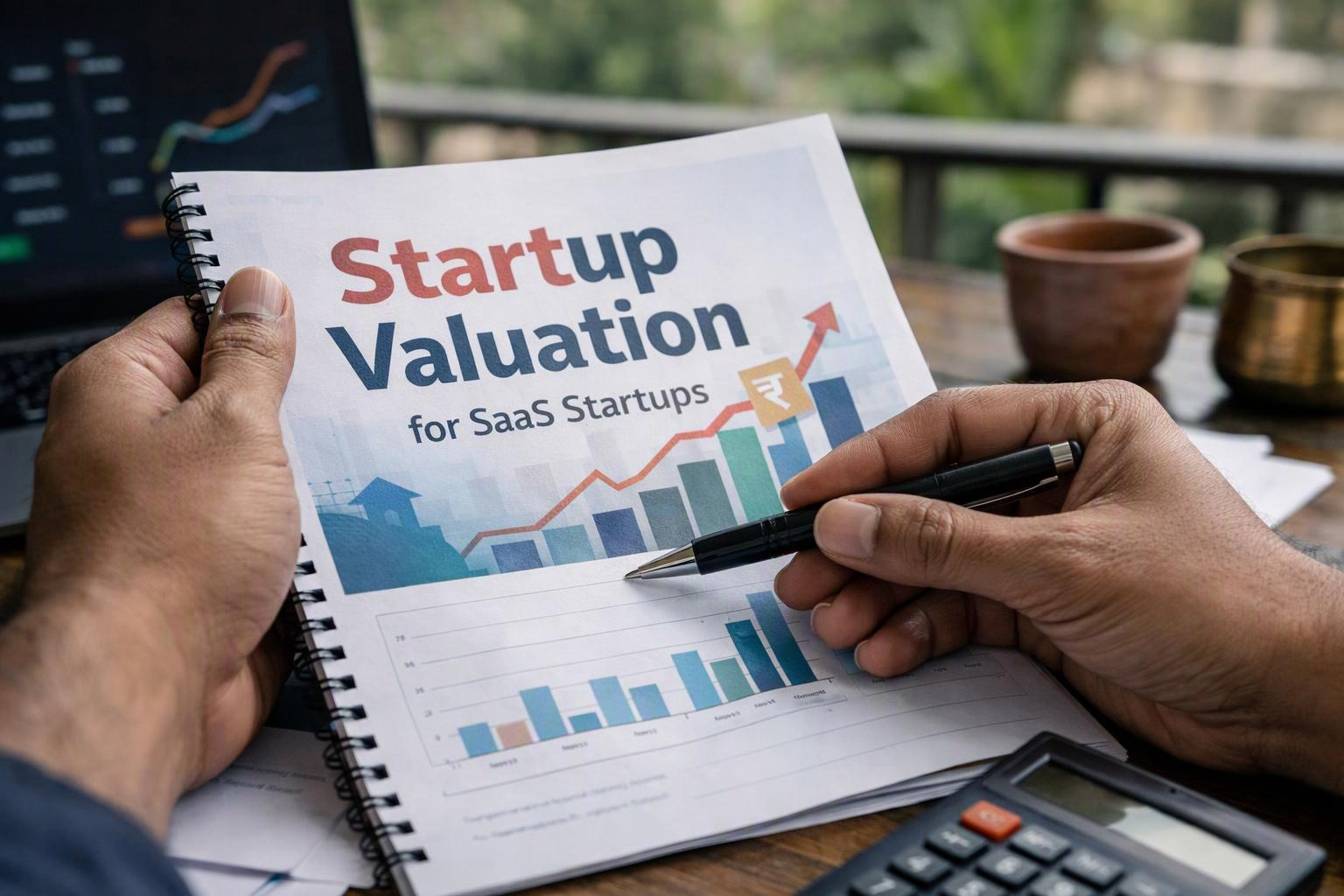
Startup Valuation for SaaS Startups
Startup valuation for SaaS startups is an evidence-based assessment of a software company's value using revenue quality, growth, retention, profitability, risk and intangible assets; StartupConsultant.Business.in carries out the business valuation, financial valuation and intangible shares valuation work through Free Consultations.
Author: Gaurav Maheshwari
What Makes SaaS Startup Valuation Different?
SaaS startup valuation differs because subscription revenue, customer retention, scalable software and intangible assets influence value alongside present financial performance.
A SaaS startup uses a subscription business model to earn recurring revenue from customer relationships. We assess the quality of that revenue by reviewing contract terms, renewal behaviour, customer lifetime value and the strength of the software assets supporting delivery.
Past financial performance still matters, but future revenue visibility can carry significant weight. Our team connects operating evidence with financial analysis so that the conclusion reflects both current results and the business model's ability to scale.
Why SaaS Startups Need a Formal Valuation
A formal SaaS valuation gives founders and stakeholders a reasoned view of value for a defined business purpose. We organise the evidence around the decision that requires the valuation.
We state the valuation purpose before selecting the method. This prevents a general estimate from being used for a decision that needs a more specific scope.
How SaaS Startups Differ from Other Businesses
A SaaS startup is assessed through revenue visibility, customer behaviour and software capability as well as its financial statements. The comparison below shows how the evidence may differ from a traditional business.
| What is being compared | SaaS startup | Traditional business |
|---|---|---|
| Revenue pattern | Often linked to recurring revenue and renewals | May depend more on individual sales or projects |
| Customer retention | Renewal behaviour and churn can directly affect forecasts | Repeat business may be assessed through different records |
| Main operating asset | Software platform, intellectual property and customer data | May rely more on physical assets, stock or established processes |
| Cost profile | Product development and customer acquisition can precede scale | Costs may track production, premises or direct service delivery |
| Evidence focus | Cohorts, retention, contracts and software ownership | Trading records, assets, contracts and operating history |
These differences do not remove the need for financial discipline. We use the business model to decide which records deserve closer testing and how they support the valuation conclusion.
Which SaaS Metrics Matter to Valuation?
SaaS valuation considers the quality, predictability and scalability of recurring revenue together with retention, margins, growth efficiency and cash requirements.
We review annual recurring revenue and monthly recurring revenue to understand the contracted revenue base. Revenue growth shows commercial momentum, while churn and net revenue retention reveal whether customers remain and expand their use of the product.
Gross margin helps show how efficiently the software can serve customers. Customer acquisition cost and customer lifetime value help us assess growth efficiency, while burn rate and cash flow show the funding needs behind the forecast.
Revenue Quality and Retention
Revenue quality reflects how dependable, transferable and repeatable the income appears. We examine recurring revenue, contracted revenue, renewal terms and the customer mix supporting the forecast.
Churn rate shows customer loss, while net revenue retention shows how the existing customer base changes after renewals, expansion and reductions. Our team uses cohort analysis to identify patterns that a total revenue figure may hide.
Growth, Margin and Cash Generation
Revenue growth matters most when it is supported by sustainable margins and credible cash requirements. We assess gross margin, operating margin, burn rate and cash flow together so that growth is not viewed in isolation.
A credible path to profitability depends on the financial projections, operating plan and funding assumptions. We test whether the forecast is consistent with customer acquisition activity, product spending and the available cash position.
Which Valuation Methods Apply to SaaS Startups?
SaaS startups are commonly assessed through income, market and cash-flow methods, with the appropriate method depending on business maturity, financial evidence and transaction purpose.
The income approach considers the earnings or cash flows that the business can generate. Discounted cash flow may be relevant when financial projections are detailed enough to support assumptions about future performance and a suitable discount rate.
The market approach uses market comparables, revenue multiple evidence and relevant precedent transactions. An earnings multiple may be more useful when the SaaS startup has stable earnings, while a revenue-based comparison may receive more attention when growth and recurring revenue are central to the evidence.
We select and reconcile methods rather than relying on a single output. The result is explained in a valuation report with the valuation date, assumptions and limitations clearly stated.
What Features Matter Most in a SaaS Valuation?
A SaaS valuation gives greater weight to features that support dependable revenue and scalable delivery. We connect each feature to evidence that can be reviewed during due diligence.
We also review software ownership and the way the product is maintained. These matters can affect both the financial valuation and the intangible asset analysis.
What Challenges Can Reduce SaaS Startup Value?
SaaS startup value can be reduced when revenue depends on fragile relationships, unsupported assumptions or assets that are difficult to transfer. We identify these issues so that their effect is reflected in the valuation reasoning.
Our team separates temporary operating pressure from structural risk. We then explain how the evidence affects the selected method and the final valuation conclusion.
How We Assess a SaaS Startup
We assess a SaaS startup through a structured review of its records, ownership, operating evidence and valuation purpose. Each step helps us build a conclusion that can be understood and supported.
Our work is available through Free Consultations, where we first clarify the assignment and the records needed for the review.
What Documents Support a SaaS Valuation?
A SaaS valuation is supported by financial statements, recurring revenue records, customer data, ownership documents, forecasts and details of the valuation purpose.
Useful records include the profit and loss statement, balance sheet and cash-flow statement. We also review subscription contracts, customer cohort data, the cap table, software ownership records and the business plan.
Financial projections should explain the commercial assumptions behind growth, retention, costs and cash flow. Our team compares those assumptions with available operating evidence and records any material limitations in the valuation report.
How the Valuation Scope Changes the Work
The valuation purpose determines the scope, evidence, assumptions, valuation date and reporting requirements for a SaaS startup.
A business valuation may focus on the overall company and its enterprise value. A financial valuation may be prepared for a defined reporting, transaction or decision-making need.
An intangible shares valuation may require closer review of intellectual property, software ownership and the rights attached to particular shares. Equity valuation and share transfer work also depend on the cap table, shareholder rights and the relevant transaction terms.
Fundraising, tax and compliance purpose, mergers and acquisitions and internal shareholder decisions can each require a different report structure. We confirm the scope before applying the income approach, market approach or discounted cash flow method.
How to Request a SaaS Startup Valuation
StartupConsultant.Business.in scopes a SaaS startup valuation after reviewing the business purpose, valuation date, ownership structure, financial evidence and relevant software assets.
Begin by preparing a valuation brief that explains why the valuation is needed, which interests are being assessed and which records are available. We then clarify the required business valuation, financial valuation or intangible shares valuation scope.
Our team reviews the information, identifies the appropriate valuation methodology and confirms the evidence required for the valuation report. You can request a consultation through Free Consultations.
StartupConsultant.Business.in carries out the agreed SaaS startup valuation and explains the conclusion in a clear report suited to the stated valuation purpose.
Questions About SaaS Startup Valuation
Can a SaaS startup be valued before it becomes profitable?
Yes, StartupConsultant.Business.in can value a SaaS startup before profitability when the available evidence supports a reasoned assessment. We review recurring revenue, retention, growth, margins, cash requirements, financial projections and intangible assets, then select a method suited to the business maturity and valuation purpose.
How do recurring revenue and churn affect SaaS startup valuation?
Recurring revenue can support forecast visibility, while churn can weaken the expected durability of that revenue. We assess both measures with net revenue retention, customer contracts and cohort analysis to understand the quality of the customer base.
Which documents should founders prepare for a SaaS valuation?
Founders should prepare financial statements, revenue records, subscription contracts, customer cohort data, the cap table, software ownership records, financial projections and the business plan. We also need the valuation purpose and valuation date to define the work correctly.
How does intellectual property affect the value of a SaaS startup?
Intellectual property can support value when the SaaS startup owns or controls the software, data rights and related assets needed to deliver its service. We review software ownership, transfer rights, protection, dependencies and related risks as part of the valuation analysis.
When should founders obtain an updated SaaS startup valuation?
Founders should obtain an updated SaaS startup valuation when the valuation purpose, ownership structure, financial evidence or material software assets have changed. We also reassess the scope when a new fundraising, share transfer, reporting need or transaction requires a current valuation date.
StartupConsultant.Business.in provides business valuation, financial valuation and intangible shares valuation work for SaaS startups through Free Consultations. Share your valuation brief and contact us for a scope based on your purpose, records and software assets.