
Startup Cap Table and Share Valuation Mistakes to Avoid
Startup share valuation mistakes often arise from unclear equity records, unsuitable valuation methods and undocumented assumptions. StartupConsultant.Business.in checks cap table data, reviews valuation logic and supports shares valuation and intangible shares valuation decisions.
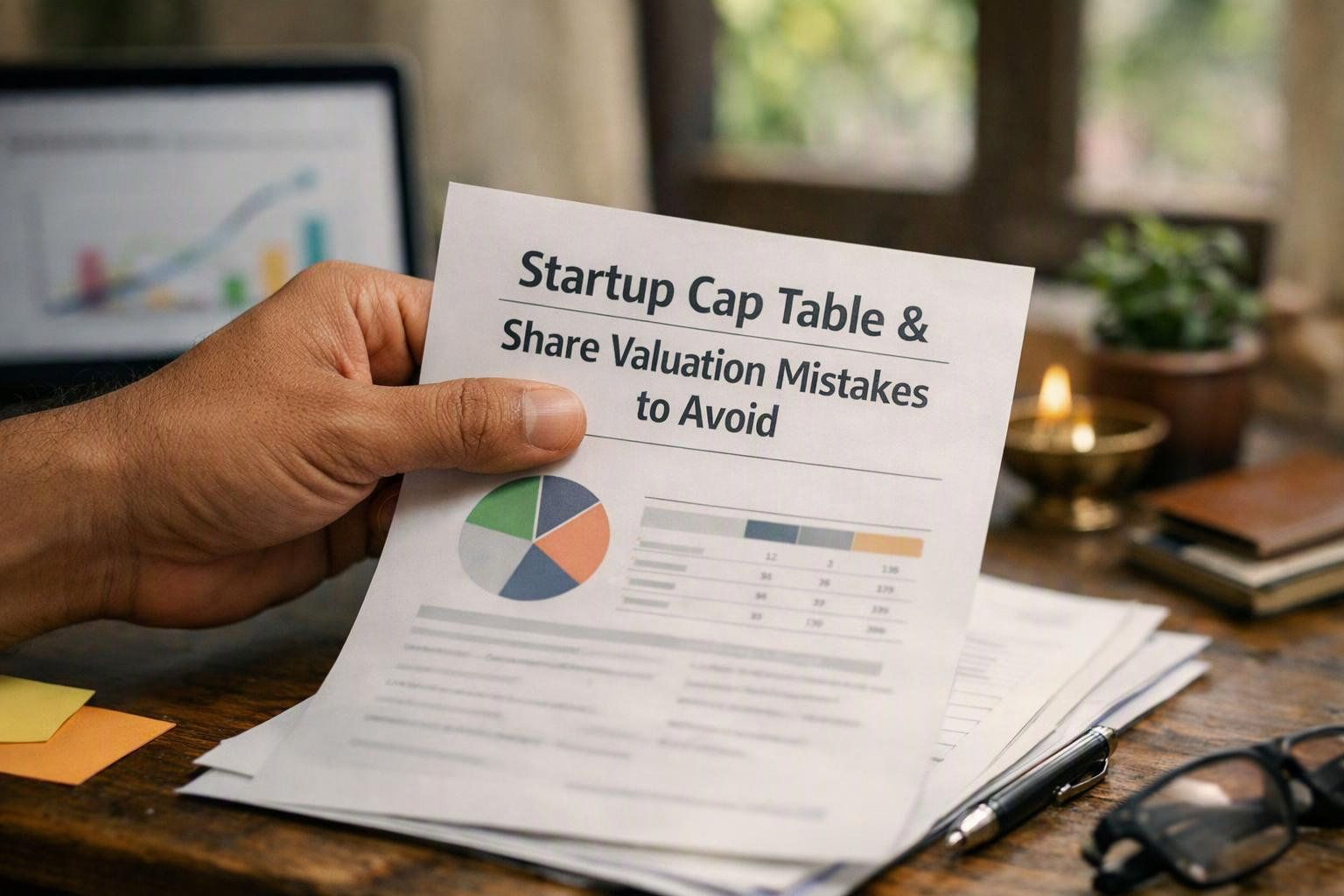
Startup share valuation is undermined by cap table, equity allocation and valuation process mistakes.
Author: Gaurav Maheshwari
Why Startup Share Valuation Mistakes Affect Ownership Decisions
Startup share valuation mistakes affect ownership decisions because incorrect inputs can distort each holder’s relative equity position and the value attributed to the business.
A cap table records the equity structure of a startup, but it also needs to reflect share classes, vesting terms and shareholder rights. When those details are incomplete, equity ownership may look clear while producing an unreliable share value.
We connect the ownership records to the rights attached to each holding. Our review helps separate the value of the business from the value available to each class of shareholder.
The Startup Cap Table Checks That Should Come First
A startup cap table check should reconcile issued shares, reserved equity, convertible instruments and ownership percentages before valuation work begins.
We begin with ownership reconciliation because a valuation conclusion cannot be reliable when the underlying equity record is incomplete.
These checks show whether the stated equity ownership reflects the legal and economic position. We then use the reconciled data in the valuation analysis.
Mistake 1: Treating the Cap Table as a Simple Share List
Treating a cap table as a simple share list hides the rights and conditions that affect ownership.
This mistake happens when shareholders record only names and quantities. Vesting, transfer restrictions and different share classes may be left outside the main record.
The cost is a distorted view of equity ownership and a valuation that may not match the rights held by each shareholder. We fix the issue by reconciling the cap table with incorporation records, shareholder agreements and vesting terms.
Mistake 2: Ignoring Options, Warrants and Convertible Instruments
Ignoring employee options, warrants, convertible notes and SAFE instruments can understate fully diluted ownership.
This mistake happens when instruments are treated as separate financing records instead of potential equity claims. Conversion terms, exercise conditions and valuation triggers can change the ownership analysis.
The cost is unexpected dilution during an investment or sale process. We review each instrument and model its relevant effect before finalising the share valuation.
Mistake 3: Using the Last Funding Round as the Current Share Value
The last funding round issue price does not automatically represent the current fair value of every share.
A funding round may include rights that ordinary shareholders do not receive. Liquidation preference, investor protections and changed market conditions can also affect the relationship between issue price and fair value.
The cost is an unsupported value in investor negotiations, tax work or internal decisions. We assess the funding context, share rights and current business evidence before deciding how much weight to give the earlier issue price.
Mistake 4: Choosing a Valuation Method Without Matching the Startup’s Stage
A valuation method should match the startup stage, revenue model and quality of available evidence.
A discounted cash flow method may depend heavily on financial projections. A market approach may require suitable comparison evidence, while an asset approach may be more relevant where identifiable assets carry much of the value.
The cost is a valuation that appears precise but rests on unsuitable inputs. We select and explain the method that fits the business purpose, available data and commercial circumstances.
Mistake 5: Valuing Intangible Shares Without Separating the Underlying Assets
Intangible shares valuation requires a clear link between the shares and the intangible assets owned or controlled by the startup.
Intellectual property, brand strength, software and customer relationships may support business value, but they are not interchangeable with the shares themselves. Ownership, legal protection and expected economic benefit also need review.
The cost is double counting, missed value or an unsupported conclusion about business share value. We identify the relevant intangible assets, assess their contribution and connect that analysis to the equity structure.
Mistake 6: Confusing Pre-Money and Post-Money Valuation
Pre-money valuation describes the business value before new investment, while post-money valuation includes the new investment.
This mistake happens when the valuation basis is not stated clearly in the funding documents. The resulting dilution and ownership percentage may then be calculated from different starting points.
The cost is disagreement over the investor’s ownership and the value assigned to existing holders. We state the valuation basis, investment treatment and dilution effect in a consistent analysis.
Mistake 7: Failing to Document Valuation Assumptions
A valuation report must document the assumptions that support its conclusion.
Financial projections, discount rate, growth assumptions and expected funding conditions can materially affect the result. Undocumented assumptions make the analysis difficult to review or update.
The cost is weak decision support and avoidable disputes during investor negotiations. We record the basis for each key assumption and test whether the conclusion remains reasonable when the evidence changes.
Mistake 8: Applying One Share Value to Every Transaction
One share value may not suit ordinary shares, preference shares, employee shares and restricted holdings.
Different share rights, transfer restrictions and liquidity conditions can affect the value attached to each class. A transaction purpose may also require a different assessment from an internal planning exercise.
The cost is an unfair or unsuitable result for the transaction. We analyse the share rights and apply the valuation basis that fits the relevant transfer or decision.
Mistake 9: Overlooking Tax, Compliance and Transaction Context
Tax valuation and regulatory compliance depend on the purpose and context of the share assessment.
This mistake happens when a valuation prepared for one purpose is reused for employee equity, a share transfer or another transaction without review. The relevant documents and reporting basis may differ.
The cost is a conclusion that does not support the intended transaction. We identify the transaction purpose, review the required evidence and explain any limitations that affect its use.
How to Correct a Startup Share Valuation Before It Is Used
A startup share valuation can be corrected by reconciling ownership records, reviewing share rights, matching the method to the purpose and testing the supporting assumptions.
Our correction process follows the evidence trail from the cap table to the final valuation conclusion.
We use this sequence to prevent a polished report from concealing an unresolved ownership problem.
What a Sound Startup Share Valuation Review Should Show
A sound startup share valuation review should show the ownership data, valuation method, assumptions, share rights, conclusion and limitations in a traceable format.
The review should allow a reader to connect each important conclusion to the underlying records and stated purpose.
| Review area | What the review should show |
|---|---|
| Valuation report | Purpose, scope, conclusion and intended use |
| Cap table | Issued shares, reserved equity and potential dilution |
| Ownership analysis | Holder positions and the effect of each relevant instrument |
| Valuation methodology | Selected method and why it fits the startup |
| Assumptions | Financial, commercial and market inputs supporting the conclusion |
| Limitations | Evidence gaps, restrictions and conditions affecting use |
We present the analysis in a way that supports review by founders, shareholders, investors and advisers.
When StartupConsultant.Business.in Should Review the Valuation
StartupConsultant.Business.in should review the valuation when ownership records conflict, equity instruments are incomplete, intangible value is material or the valuation will support a significant transaction.
Our review is also useful when a previous conclusion no longer matches the cap table, business evidence or intended transaction.
We help you decide what evidence needs correction before the valuation is relied upon.
How Our Shares Valuation Service Supports Better Decisions
Our Shares valuation service connects cap table evidence, share rights and valuation assumptions so the conclusion can support a clearly defined business purpose.
We review ordinary share valuation, preference share valuation and employee share valuation issues where they affect the decision. Our team also carries out intangible shares valuation when intellectual property or other intangible assets contribute materially to the startup’s value.
StartupConsultant.Business.in is licensed under (IBBI - SFA) IBBI/RV/11/2021/14432. We provide Free Consultations so we can understand the cap table, transaction purpose and required valuation approach before the work begins.
Contact StartupConsultant.Business.in to discuss your records, valuation purpose and next steps.
Questions About Startup Cap Tables and Share Valuation
How do cap table errors affect startup share valuation?
StartupConsultant.Business.in corrects cap table errors because missing shares, rights or instruments can distort ownership and the value assigned to each holding.
Can a startup use its last funding round price as its current share value?
No, a startup cannot assume that the last funding round price is the current value for every share because the round may include different rights, preferences and market conditions.
Why do convertible instruments complicate startup share valuation?
Convertible instruments complicate startup share valuation because their conversion terms can change fully diluted ownership and future dilution.
Which valuation method suits an early-stage startup?
An early-stage startup needs a valuation method that fits its stage, revenue model, available evidence and transaction purpose.
What documents support a startup share valuation?
Startup share valuation is supported by the cap table, incorporation records, shareholder agreements, share issue documents, instrument terms and relevant financial projections.
How does intangible property affect the value of startup shares?
Intangible property can affect startup share value when intellectual property, software, brand assets or customer relationships create expected economic benefits for the business.